A coat hook that wiggles deserves attention before another bag is hung on it. A slightly backed-out screw in sound wood may be a simple hand-tool job. A stripped hole or a loose backing board is not.
Plan the project
Beginner · Work slowly by hand; stop if the fixing or material is damaged.
Tools and materials
Required tools
Materials
- No new fasteners or fillers for this simple check.
- The hook’s original mounting instructions and load limit, if available.
Is this your job?
For an existing, lightly used hook fastened with accessible screws directly into known solid wood, such as a sound wooden mounting board. The board itself must be secure. No new holes, longer screws, drywall anchors, hollow doors, adhesive hooks or overhead fittings are included.
Before you start
Remove everything from the hook first. Do not use a coat hook as a handhold, grab bar or lifting point. If you cannot confirm the mounting material, the board moves, or there is split or soft wood around a screw, leave the hook unloaded and arrange a proper fixing repair.
What each tool does
Correct-size manual screwdriver or bit driver: Check the existing screws without driving them with power. Work light: Inspect the wood and the fixing points.
Check the result
If the existing fixing seats properly, keep use within the verified rating and check for movement during normal use. If it loosens again, leave it unloaded and have the fixing repaired instead of repeatedly tightening it.
Project steps
Unload and examine
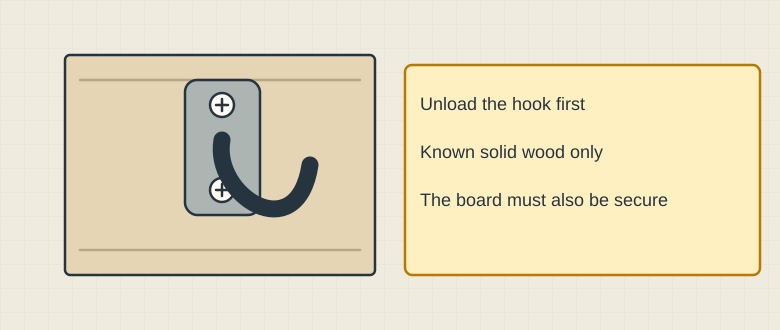
Schematic illustration. Example hook on a solid-wood board. A moving board, damaged hook or unknown backing ends this task. Take off coats and bags. Look at the hook base, screws and wood. Check whether the hook is moving on its base or the whole mounting board is moving. A loose board or damaged hook ends this task.
Confirm this is the right fixing
Continue only when you know the existing screws go into solid wood and the hardware is intended for it. A wall covering that looks like wood does not establish what is behind it. Do not remove screws or drill exploratory holes to find out.
Seat the correct screwdriver
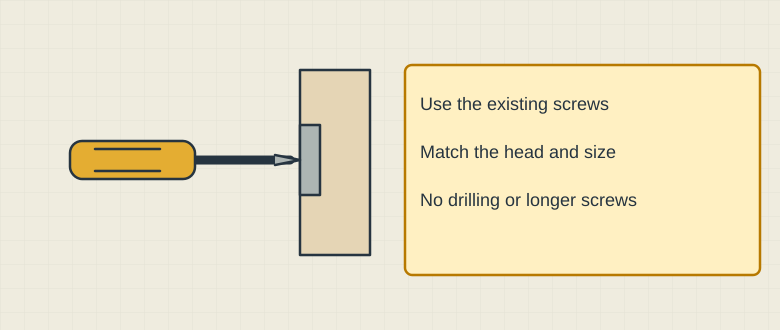
Schematic illustration. Keep a matching manual screwdriver aligned with the existing screw. Do not change the fixing method. Use the matching head type and size. Keep the driver aligned and your free hand out of its slip path. If the head is damaged or the fixing is concealed, stop rather than switching to pliers or prying off the base.
Gently secure a backed-out screw
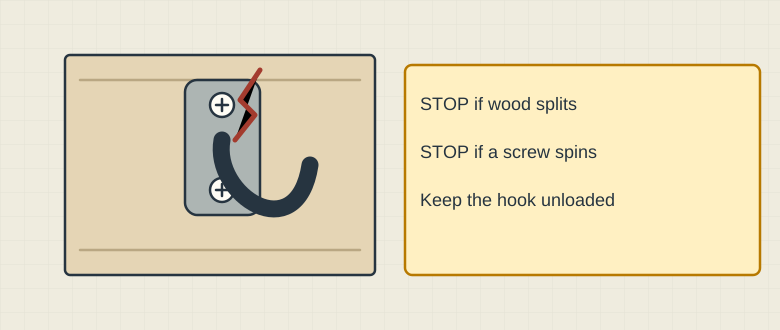
Schematic illustration. Illustrated warning: split wood or a spinning screw needs a proper fixing repair. Do not load-test the hook. Tighten an existing loose screw by hand in small movements until the hook base seats against the wood. If there are two screws, work gradually between them. Do not keep turning after it is seated. Stop immediately if a screw spins, the wood cracks, or the base remains loose.
Check without loading it heavily
Check for remaining movement with a gentle touch; do not hang your body weight or a heavy bag on it as a test. Tightness does not establish a load rating. Follow the actual hook and mounting-system limit; if that limit or the mounting quality is unknown, keep it unloaded until verified.
Safety & limits
- Remove everything from the hook first. Do not use a coat hook as a handhold, grab bar or lifting point. If you cannot confirm the mounting material, the board moves, or there is split or soft wood around a screw, leave the hook unloaded and arrange a proper fixing repair.
- Filling a damaged hole with whatever is nearby and calling it repaired. A fixing repair needs its own assessed method.
- Driving a longer screw into an unknown backing. That changes the job and can encounter concealed services.
- Treating a hook that feels firm as a support for a person. It is not a grab bar.
Sources & further reading
These links document the information used in this article. Manufacturer specifications and source research are not hands-on test results or an endorsement of a purchase.
- CCOHS: general screwdriver safety (Canadian guidance, not US code or task approval)
Reference checked 2026-10-29