Is this the right job?
For an ordinary accessible household drawer with a sound, dry base, using a non-adhesive liner compatible with its finish. Leave the drawer installed. This does not cover damp or mouldy cabinets, damaged runners, food-contact surfaces or appliance interiors.
Tools to gather
- Tape measure or ruler — Measure the usable drawer base.
- Pencil and straightedge — Mark a clear cutting line on the liner backing side.
- Suitable scissors — Cut the selected liner on a separate stable work surface.
Materials
- Compatible non-adhesive drawer liner.
- Soft cloth and finish-compatible cleaning materials.
- A protective cutting surface.
1Empty and clean
Take the contents out and check the base. Clean using a method safe for the finish, then let it dry fully. Put loose sharp objects somewhere secure while you work.
2Measure the usable area
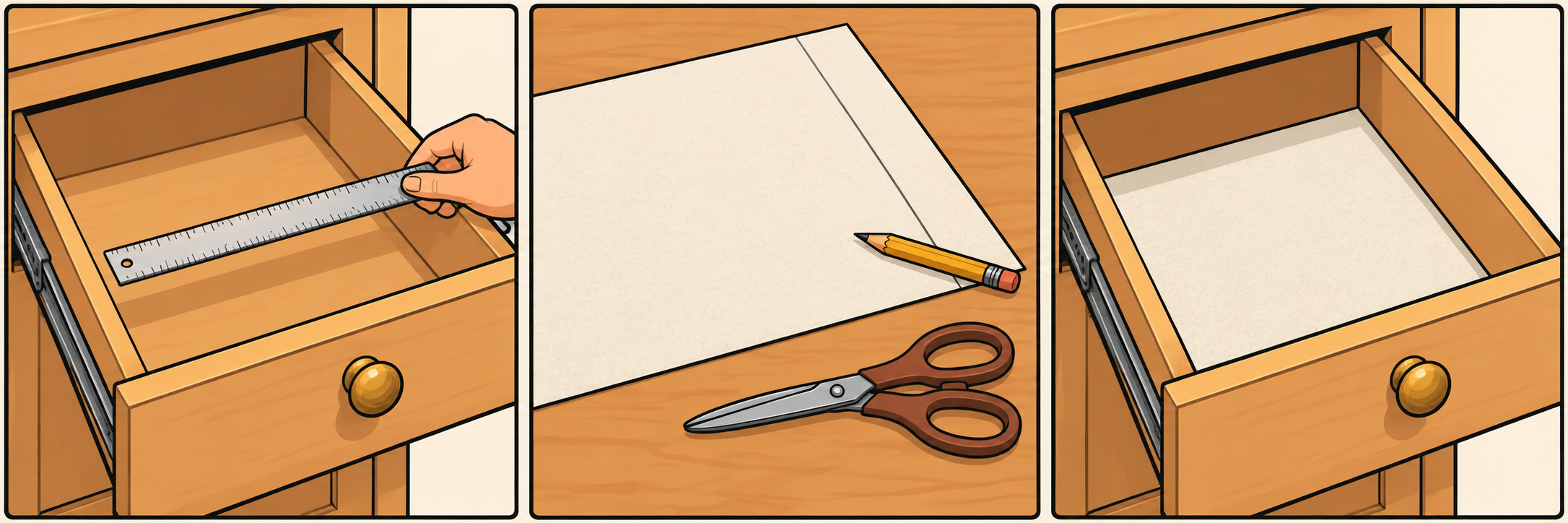
Measure width and depth inside the drawer, allowing for its actual shape and obstructions. Keep one set of units throughout; 1 inch equals 25.4 mm. The liner must not reach into runners or prevent the drawer closing.
3Mark and cut
Lay the liner flat on a stable protected worktop, using its instructions to identify the correct face. Mark the shape with a straightedge. Cut with suitable scissors, keeping the other hand away from the blade path. Close the scissors when finished.
4Try the fit before filling
Lay the piece loosely in the drawer. It should lie flat without curling against the sides. Mark any adjustment, take it back to the work surface and trim there. Do not add glue to a liner intended to be removable.
5Check normal use
Open and close the drawer gently, then replace a few items and try again. If the liner bunches or obstructs movement, refit it or choose a compatible alternative. Lift it periodically to check for dirt or trapped moisture and follow its cleaning instructions.
Common mistakes to avoid
- Cutting directly on the drawer's finish.
- Adding adhesive to make an unsuitable liner stay put.
- Covering dampness or damaged material instead of investigating it.